On a recent trip to Brazil, at the invitation of business leaders in São Paulo, El Salvador’s Security Minister Gustavo Villatoro declared that “as people of faith, alongside President Nayib Bukele,” he had a moral obligation to explain how they won the battle against the gangs, “those beings of darkness.”
As ridiculous as it may sound —especially since said “beings of darkness” were his president’s political partners for many years— Villatoro’s messianic rhetoric was no accident. He was speaking in a country where evangelical churches exert enormous influence over the vote. Villatoro addressed four presidential candidates from Brazil’s right wing, just days before the first round of the presidential election.
Flavio Bolsonaro, the frontrunner among them, had already visited El Salvador to “see the Bukele model firsthand” and returned to Brazil to promise its implementation.
In Latin America, the seven presidential elections preceding Brazil’s were won by candidates who praised the Bukele model or openly adopted it. This list includes Milei, Kast, Noboa, Fujimori, De La Espriella, Fernández, and Asfura.
Colombian candidate Abelardo de la Espriella has gone so far as to imitate Nayib Bukele’s aesthetic and mannerisms. Laura Fernández has just inaugurated the CACCO in Costa Rica, a mega-prison inspired by El Salvador’s CECOT; and Keiko Fujimori made a pilgrimage to San Salvador last week to be photographed against the backdrop of Bukelista imagery: the president and his prison.
Keiko Fujimori’s father Alberto, who ruled Peru from 1993 to 2000, severely restricted citizens’ rights and dealt a coup against the legislature — just as Bukele attempted against the Assembly in 2020, then carried out against the judiciary in 2021. Now, Villatoro, El Salvador’s security chief, gave Keiko a guided tour of the region’s signature megaprison, offering a glimpse at Bukele’s now-subjugated creatures of the darkness.
This does not mean, of course, that the Bukele model is the reason for the far right’s electoral victories. But it is a clear illustration of the coordinated strategy of this American far right: opportunistic security rhetoric justifies the true agenda of power concentration, impunity, and population control.
Biblical language and alliances with evangelical churches form another throughline.
Another equally visible element is their alignment with the MAGA movement in the United States and the so-called “Donroe Doctrine” promoted by President Donald Trump, anchored in the Shield of the Americas. Yet another is their contempt for human rights, environmental policies, and science; their disregard for opponents and critics; and their hate speech against anything that does not align with their agenda. Their dehumanization of the other.
Trump Seizes Venezuela
Flavio Bolsonaro makes common cause on all of the above, as did his father and political mentor, Jair, who was sentenced to 27 years in prison for attempting to incite hordes of supporters to violently storm Brasília, the capital, and reinstate him as president following his electoral defeat against Lula in 2022.
This year, Flavio Bolsonaro won the first round, and his victory in the second round over Lula seemed inevitable. Everything pointed to the Latin American far right —which increasingly resembles an international criminal organization— taking control of the continent’s largest economy. The dictator of the smallest country in continental America, El Salvador’s Nayib Bukele, became the epicenter of the extremist wave with flying colors. And it seemed Donald Trump would submit —with the exceptions of Uruguay and Mexico (Cuba, Nicaragua, and Venezuela are separate cases)— the entire region under his command.
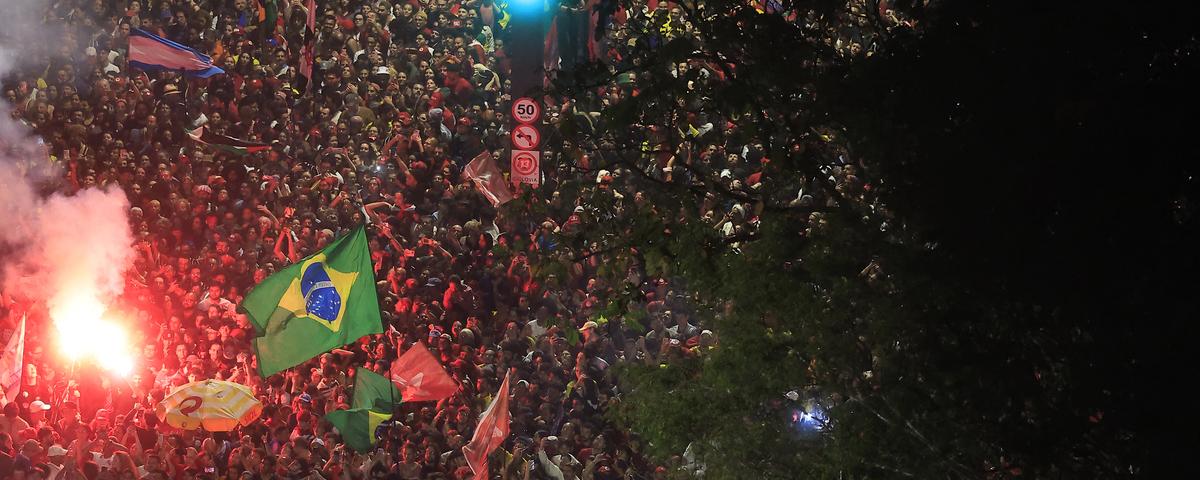
This is precisely what did not occur in Brazil. Its citizens, mobilizing at the last minute, thwarted this plan, preventing the complete abandonment of the Amazon, the severe deterioration of their democratic life, and the wiping out of universal human rights and the rule of law.
None of this is to say that Lula is —borrowing from Villatoro’s biblical spiel— a being of light dueling with shadows. He is an octogenarian incapable of making room for new leadership; a president who had a poor third term; the leader of a party that has become a political machine, one that has lost its vigor and spirit of sacrifice for principles and has replaced them with bureaucracy, addiction to power, corruption, and complacency. This has led Brazilians from hope to frustration and even outrage. Or perhaps resignation.
But his epic victory in the runoff has prevented what would have happened had Bolsonaro won.
The Art of the Deal… to Save a Criminal
The Bukele model has suffered its first major blow. So has the Donroe doctrine. So have the tech barons who helped Bolsonaro amplify his messages. So have those who were already preparing contracts for extractive industries in the Amazon. So have the financial markets that got carried away by the forecasts. Everyone believed Bolsonaro’s victory was inevitable.
Lula won by more than four million votes. Flavio, under investigation by his country’s justice system, fled by illegally crossing the border into Argentina, aided by the Milei administration. There, he boarded a private plane that took him to Noboa’s Ecuador, and then to Florida, from where he will follow today’s results of the congressional and state elections in the United States.
It is too early to know whether this setback for the regional right is an exception or the beginning of a popular backlash, like the one we are seeing in Serbia or the one we saw in Hungary. Or perhaps it is resistance to the Trumpist agenda in the region, led jointly by Latin America’s two major economies: Brazil and Mexico.
But the future of the continental far right will hinge on the results of the U.S. midterm elections and the reaction of President Trump and his MAGA movement, which has embraced the Bukeles across the continent. We’ll find out very soon.